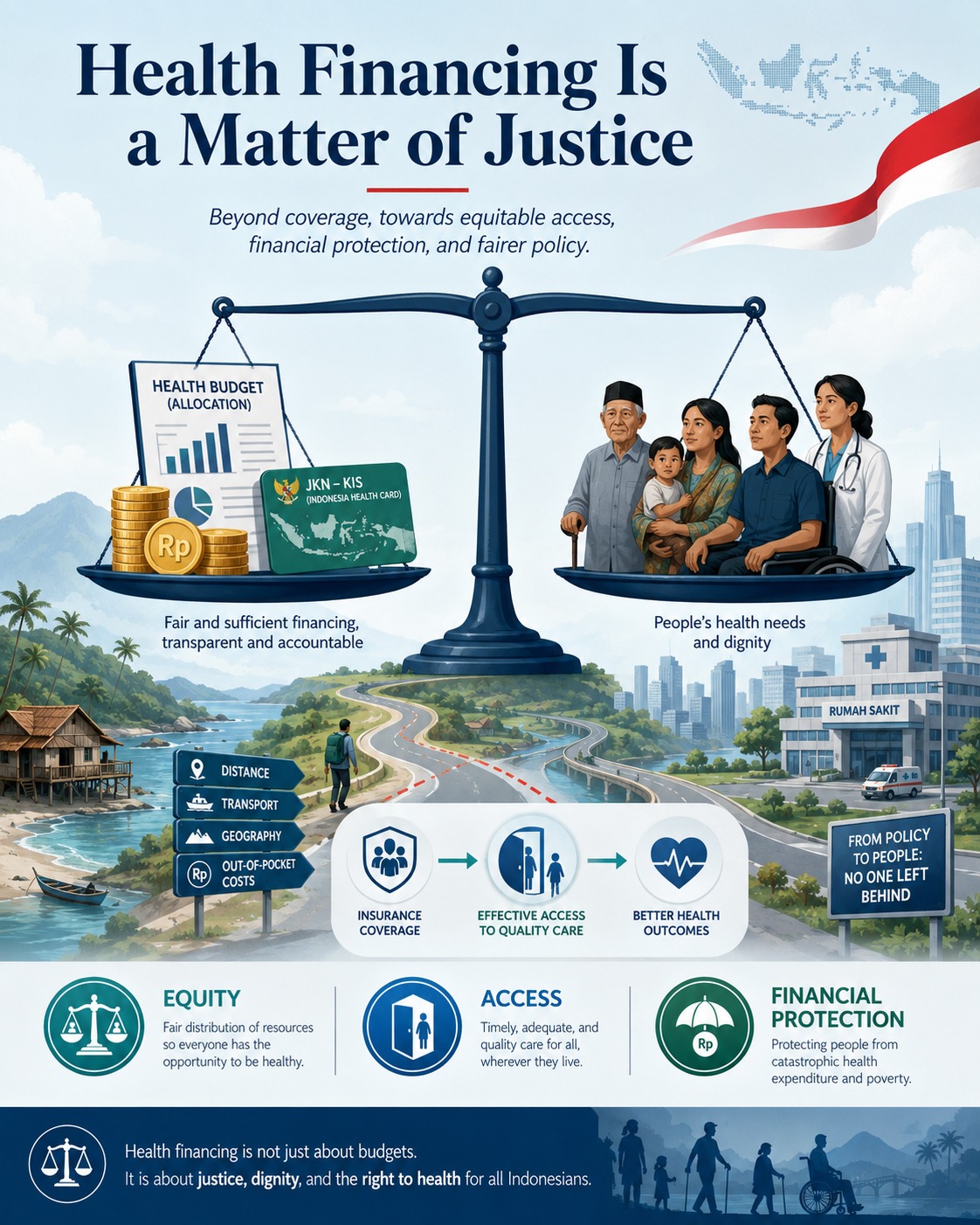
Equitable Health Financing: From Administrative Coverage to Substantive Justice
By dr. Yan Aslian Noor, M.P.H., FISQua
Health financing is one of the most important foundations of a fair, resilient, and sustainable health system. Yet it should not be understood merely as a technical matter of budgets, premiums, subsidies, or expenditure control. At its core, health financing is a question of justice: who pays, who benefits, who remains excluded, and how far the system protects people from financial hardship when they need care.
At the global level, health financing has become an increasingly urgent policy issue. Global health expenditure reached approximately US$9.8 trillion in 2022, equivalent to around 9.9% of global GDP. This demonstrates that health is no longer a peripheral public sector concern, but a major fiscal and social priority. However, the distribution of health spending remains deeply unequal. High-income countries generally have greater fiscal capacity, while many low- and middle-income countries continue to face limited budgetary space, unequal access to services, and a heavier reliance on out-of-pocket payments.
This global imbalance provides an important context for Indonesia. OECD countries were estimated to spend an average of 9.3% of GDP on health in 2024, while Indonesia’s health expenditure was approximately 2.7% of GDP in 2023. This gap highlights a central policy challenge: Indonesia has made major progress in expanding health insurance coverage, but its fiscal capacity for health remains relatively limited compared with more mature health systems.
A person may be insured, yet still struggle to access timely and quality care. Barriers may include geographical distance, long waiting times, limited specialist services, uneven facility distribution, indirect transport costs, and differences in service quality across regions. This is the critical gap between being registered in the system and being genuinely protected by the system.
Indonesia also continues to face a financial protection challenge. Out-of-pocket spending remains around 27.5% to 28.3% of total health expenditure. This indicates that many households may still carry direct or indirect financial burdens when seeking care. In health financing terms, this matters because high out-of-pocket payments can delay treatment, deepen inequality, and increase the risk of catastrophic health expenditure.
The urgency, therefore, is not only to increase health spending, but to ensure that health resources are allocated, used, and monitored fairly. A health financing system cannot be judged solely by how many people are enrolled. It must also be judged by whether people can obtain the care they need, at acceptable quality, without being pushed into financial difficulty.
This is where strategic advocacy becomes essential.
Health financing policy is not shaped by technical evidence alone. It is also influenced by political priorities, institutional interests, fiscal negotiations, public pressure, and the capacity of actors to translate evidence into persuasive policy narratives. Strategic advocacy plays a crucial role in this process by connecting data, patient experience, institutional dialogue, public communication, and coalition-building.
Advocacy should not be reduced to protest or aspiration. In the context of health financing, it is a disciplined policy instrument. It helps identify priority issues, map stakeholders, build evidence-based arguments, mobilise coalitions, communicate policy messages, and monitor whether commitments are reflected in regulations, budgets, and implementation.
The key gap in Indonesia’s health financing reform lies in the distance between coverage expansion and equitable benefit. The country has made strong progress in enrolment, but further progress is needed in access, quality, financial protection, and fair distribution of resources. Without strategic advocacy, equity risks being overshadowed by fiscal efficiency, administrative targets, and short-term budgetary considerations.
The target of strategic advocacy should be clear: to promote a health financing policy that is fair, transparent, accountable, and responsive to people’s needs. This means strengthening financial protection, reducing out-of-pocket burdens, improving budget transparency, prioritising underserved regions, reinforcing primary care, ensuring more equitable subsidies, and embedding the voices of vulnerable groups in policy decision-making.
Equitable health financing requires a shift in perspective. Health budgets should not be seen merely as fiscal expenditure, but as social investment. JKN should not be understood only as an administrative insurance mechanism, but as a social protection instrument. Advocacy should not be viewed merely as communication, but as a strategic process for ensuring that public policy serves those most at risk of being left behind.
Ultimately, the future of health financing in Indonesia must be guided by a simple but powerful principle: no one should be denied meaningful access to healthcare because of where they live, how much they earn, what kind of work they do, or how difficult it is for them to reach services.
A just health system is not one that only promises rights on paper. It is one that delivers real, timely, affordable, and dignified care for all.