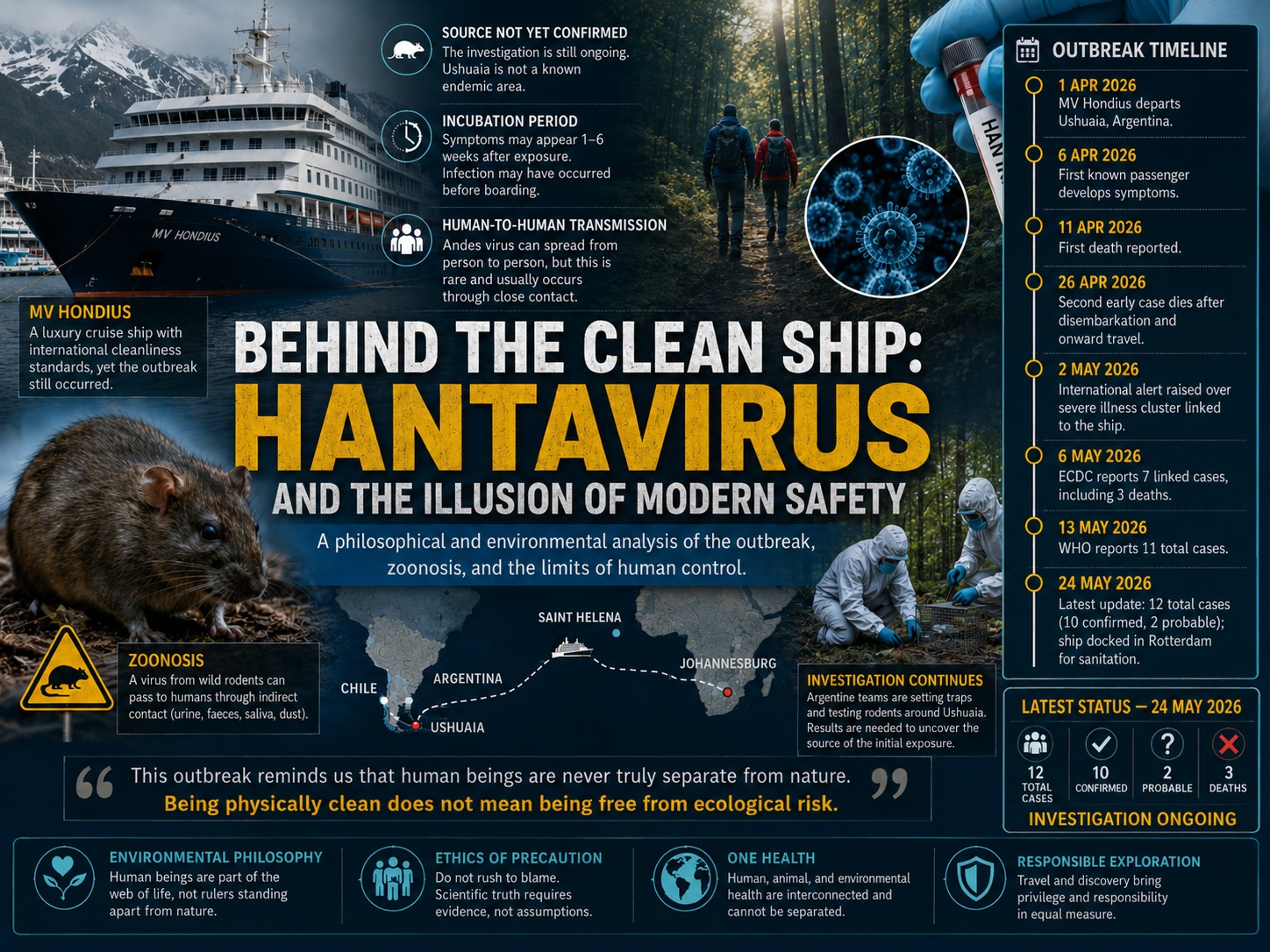
Behind the Clean Ship: Hantavirus, Ecological Uncertainty, and the Fragile Illusion of Modern Safety
The preliminary reconstruction of the hantavirus cluster associated with the MV Hondius invites a more sober and philosophically attentive reading than any hasty verdict would allow. At first glance, the incident appears to sit uneasily with modern expectations: a cruise vessel, operating within international standards of cleanliness and maritime order, becomes entangled in a severe zoonotic outbreak. Yet this apparent contradiction is precisely what makes the case so intellectually compelling. It reminds us that cleanliness, however meticulously performed, is not the same as ecological invulnerability.
The most plausible working hypothesis, as presented in the attached chronology, is that the initial infection may have occurred before embarkation, during the suspected early cases’ overland travels through Chile and Argentina, followed by their stay in Ushuaia for bird-watching and trekking before boarding the MV Hondius on 1 April 2026. However, the exact site of exposure remains unproven, and the hypothesis linking the source to Ushuaia or Tierra del Fuego remains contested, particularly because the area had not previously been known as a recorded hantavirus locality.
This is where the matter becomes less a simple story of disease transmission and more a parable of epistemic humility. Science, at its best, does not put the cart before the horse. It does not transform suspicion into certainty, nor chronology into causality. The fact that symptoms emerged after the passengers had boarded the ship does not, by itself, establish the ship as the site of infection. Hantavirus pulmonary syndrome may develop after a variable incubation period, meaning that the visible moment of illness may be separated by days or weeks from the invisible moment of exposure. The chronology, therefore, cautions against a simplistic inference: to fall ill at sea is not necessarily to have been infected at sea.
From an environmental perspective, the case illustrates the porous boundary between human mobility and ecological risk. The modern traveller does not move through a sterile world. Every itinerary carries with it a trail of ecological encounters: forest paths, rural lodgings, dust, soil, animal reservoirs, human contact, and microbial possibilities. In this sense, the passenger is not merely a traveller across geography, but also a bearer of environmental history. The ship is not the origin of the story, but one chapter within a broader landscape of exposure.
The investigation in Ushuaia further underscores this complexity. Argentine scientists reportedly undertook rodent trapping and testing in the area, not because Ushuaia had been proven to be the source, but because uncertainty demanded empirical inquiry. Such a field investigation is not a declaration of guilt; it is the patient work of tracing a shadow back to its possible ecological form. As the chronology notes, the presence of related rodent subspecies in the region raises questions that require laboratory confirmation, not public speculation.
This distinction is ethically crucial. In the aftermath of outbreaks, public imagination often hungers for a culprit: the dirty ship, the careless company, the infected tourist, the negligent authority, or the suspicious animal. Yet the moral landscape of zoonotic disease is rarely so neat. To apportion blame before evidence is to build castles in the air. A responsible analysis must resist the temptation to turn epidemiological uncertainty into accusation. At the same time, caution must not become complacency. Transparency, contact tracing, environmental testing, and institutional accountability remain indispensable.
The MV Hondius case is therefore best understood through a One Health lens, in which human health, animal reservoirs, and environmental conditions are inseparably interwoven. The chronology suggests that the dominant model is not necessarily one of “many rodents on board”, but rather a possible initial zoonotic spillover followed by limited human-to-human transmission, particularly relevant because the Andes virus has been documented as capable of rare person-to-person spread.
Philosophically, the outbreak punctures a deeply modern illusion: the belief that technological order, luxury infrastructure, and international standards can fully insulate human beings from the living world. The cruise ship, gleaming and regulated, becomes a floating metaphor for modernity itself. It promises distance from danger, comfort against wilderness, and control over uncertainty. Yet zoonotic disease slips through these symbolic defences, reminding us that the wild is not always outside the vessel. Sometimes, it travels in incubation, in memory, in prior exposure, in breath, in contact, and in the unrecorded encounters between humans and other species.
There is, then, a deeper lesson here. A ship may be clean, but the world through which its passengers move is ecological. A route may be mapped, but exposure may remain hidden. A timeline may be reconstructed, but causality may resist closure. In such circumstances, scientific truth proceeds not by theatrical certainty, but by disciplined patience.
The MV Hondius outbreak should not be read as proof that modern systems have failed entirely, nor as evidence that cleanliness is meaningless. Rather, it shows that cleanliness is only one layer of protection within a much larger ecology of risk. The incident reveals the limits of a purely sanitary imagination. It asks us to think beyond surfaces and protocols, towards habitats, reservoirs, mobility, uncertainty, and the fragile entanglement of human life with the more-than-human world.
In the end, the most compelling interpretation is not that a clean ship became inexplicably dangerous, but that no human system, however polished, sails outside nature. The sea may carry the vessel, but ecology carries the story.
References
- World Health Organization. Hantavirus cluster linked to cruise ship travel, Multi-country. 2026.
- Associated Press. Argentine investigators trap rodents in Ushuaia while searching for the source of a hantavirus outbreak. 2026.
- European Centre for Disease Prevention and Control. Andes hantavirus outbreak in cruise ship. 2026.
- The New England Journal of Medicine. Andes Hantavirus Outbreak on a Cruise Ship, 2026. 2026.
- Centers for Disease Control and Prevention. CDC provides update on hantavirus outbreak linked to M/V Hondius cruise ship. 2026.
- Government of Spain / La Moncloa. The Ministry of Health coordinates response to hantavirus outbreak detected on MV Hondius. 2026