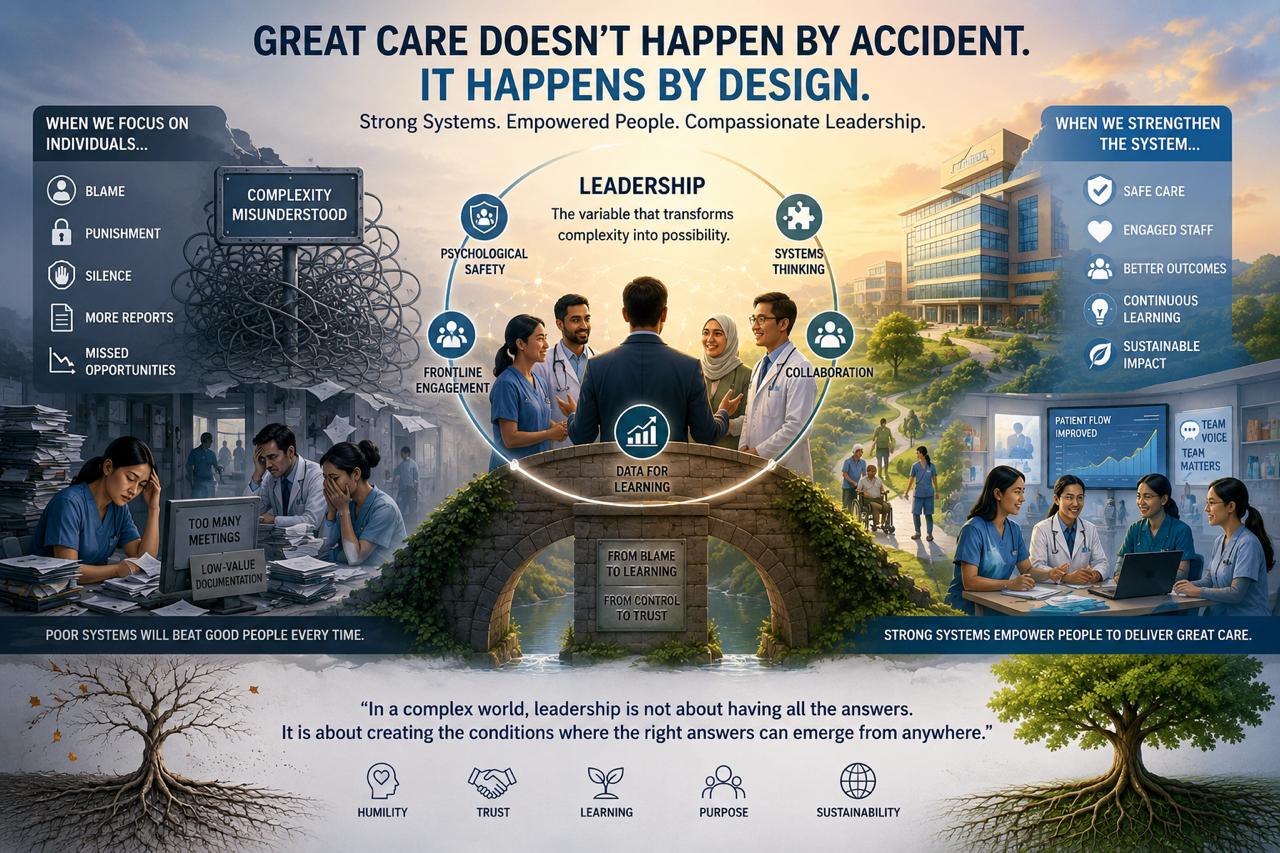
Leadership in Complex Healthcare Systems: Reflections from the WHLNet Webinar and Implications for Sustainable Health System Transformation
Beyond Individual Excellence: Why Healthcare Must Learn to Think in Systems
One of the most compelling insights from the recent WHLNet webinar, featuring Dr Vijay Agarwal and Laura, was the recognition that the greatest challenge facing modern healthcare is no longer a shortage of expertise, technology, or clinical knowledge. Rather, it is our ability to lead, coordinate, and continuously improve increasingly complex systems.
For decades, healthcare organisations have invested heavily in clinical excellence. Yet despite remarkable advances in medicine, many health systems continue to struggle with fragmented care, staff burnout, patient safety incidents, operational inefficiencies, and uneven outcomes. The webinar challenged us to ask a fundamental question:
Are we attempting to solve systemic problems with individual solutions?
This question lies at the heart of contemporary healthcare leadership.
Healthcare as a Complex Adaptive System
Dr Vijay Agarwal argued persuasively that healthcare should be understood as a complex adaptive system. Unlike simple or predictable systems, complex systems are characterised by multiple interdependent actors, dynamic relationships, feedback loops, and constantly changing conditions.
In such environments, outcomes do not improve merely because individuals work harder. Excellence emerges when information flows effectively, teams collaborate across professional boundaries, and organisations learn continuously from both success and failure.
This perspective represents a profound departure from traditional management thinking.
Historically, healthcare leadership often relied upon hierarchical models built around command, compliance, and control. Such approaches may have been effective in relatively simple systems. However, they are increasingly inadequate in contemporary healthcare, where patient journeys span multiple departments, professions, technologies, and organisational boundaries.
As complexity increases, leadership must shift from controlling people to enabling systems.
A Powerful Question: Who Is Really Responsible for Failure?
One of the most thought-provoking moments during the webinar arose from a question I posed to Dr Vijay:
If most failures in healthcare arise from system design rather than individual performance, is it still ethically justifiable to evaluate success and failure primarily at the individual level instead of assessing the system’s capacity to learn, adapt, and improve?
His response was both insightful and deeply important.
Dr Vijay argued that, in most cases, poor outcomes are not the result of individual incompetence or negligence. More often, they reflect a system’s inability to integrate people effectively into workflows, processes, communication structures, and organisational culture.
In other words, individuals frequently operate within conditions they did not create and cannot control.
This perspective aligns closely with the work of W. Edwards Deming, who famously observed that most performance variation originates from the system rather than the individual. It also resonates with James Reason’s theory of organisational accidents, which demonstrates that adverse events rarely stem from a single human error; instead, they emerge from multiple latent weaknesses within the system.
The implication is profound.
If failures are largely systemic, then a culture centred on blame is not merely ineffective—it may also be ethically flawed.
Organisations that focus solely on identifying who failed often miss the more important question:
Why did the system allow the failure to occur?
Psychological Safety: The Foundation of Learning Organisations
Another recurring theme throughout the discussion was the importance of psychological safety.
A participant observed that many organisational problems might diminish if employees felt genuinely empowered to speak openly, contribute ideas, and participate in decisions affecting care delivery.
Dr Vijay strongly agreed.
Psychological safety refers to an environment in which individuals feel comfortable raising concerns, reporting risks, questioning assumptions, and sharing ideas without fear of embarrassment, punishment, or retaliation.
Research by Amy Edmondson has consistently demonstrated that psychologically safe organisations are more innovative, more resilient, and more capable of learning from mistakes.
This is particularly relevant in healthcare.
Patient safety depends not only on protocols and technology but also on whether frontline staff feel able to say:
“Something is wrong.”
“This process is unsafe.”
“There may be a better way.”
Without psychological safety, organisations become vulnerable to silence, and silence can be dangerous.
Leadership as the Critical Variable
Laura’s contribution extended this conversation by introducing a behavioural science perspective.
She suggested that leadership itself may be the critical variable determining whether systems improve or stagnate.
Policies, regulations, strategic plans, and performance indicators are important. However, sustainable transformation ultimately depends upon human behaviour.
Healthcare systems do not function because policies exist.
They function because people interpret those policies, make decisions, build relationships, solve problems, and influence one another every day.
From this perspective, organisational transformation is fundamentally a behavioural challenge.
The central question is therefore not merely:
“What structures should we create?”
but also:
“What behaviours must leaders model and encourage if those structures are to succeed?”
This insight is particularly valuable because many healthcare reforms focus heavily on technical solutions while underestimating the behavioural and cultural dimensions of change.
Lessons from Environmental Philosophy
Perhaps surprisingly, many of the ideas discussed during the webinar resonate strongly with contemporary environmental philosophy and systems thinking.
Traditional mechanistic thinking, inherited from the Cartesian and Newtonian worldview, tends to view organisations as machines composed of separate parts. Problems are analysed by isolating components, identifying faults, and correcting them individually.
By contrast, modern ecological thinking views reality as a network of interconnected relationships.
Thinkers such as Gregory Bateson, Fritjof Capra, and Edgar Morin argue that living systems cannot be fully understood by examining isolated elements. Meaning emerges through relationships, interactions, and patterns of interdependence.
This ecological perspective provides a powerful lens through which to understand healthcare organisations.
Hospitals are not machines.
They are living social systems.
They consist not only of buildings, equipment, budgets, and organisational charts but also of relationships, trust, communication, values, learning processes, and shared purpose.
When viewed through this lens, leadership becomes less about control and more about stewardship.
The leader’s role is not to command every action but to cultivate the conditions in which healthy relationships, collaboration, learning, and adaptation can flourish.
Implications for Health System Reform
The webinar’s lessons are particularly relevant for countries pursuing large-scale health system transformation, including Indonesia.
Many healthcare organisations continue to struggle with:
* excessive bureaucracy,
* low-value reporting requirements,
* hierarchical decision-making,
* limited frontline engagement,
* fragmented communication,
* cultures of blame rather than learning.
Interestingly, participants in the webinar identified low-value documentation and excessive meetings as the most significant barriers to improving patient flow and staff experience.
This finding highlights a critical reality:
The greatest obstacles to healthcare improvement are often organisational rather than clinical.
The challenge is not a shortage of talented professionals.
The challenge is creating systems that allow talented professionals to succeed.
Conclusion
The most important lesson from the webinar may be summarised in a single statement:
The future of healthcare quality will depend less on finding better individuals and more on building better systems.
As healthcare becomes increasingly complex, leadership can no longer be understood as authority, hierarchy, or administrative oversight.
Leadership is the capacity to create conditions in which people can learn, collaborate, adapt, and improve together.
From both a systems perspective and an ecological perspective, sustainable healthcare transformation requires a shift in mindset:
* from blame to learning,
* from control to collaboration,
* from hierarchy to psychological safety,
* from individual performance alone to collective system capability.
Ultimately, the quality of care delivered to patients will reflect not only the expertise of healthcare professionals, but also the wisdom of the systems within which they work.
Suggested Reading
Bateson, G. (1972). Steps to an Ecology of Mind. University of Chicago Press.
Capra, F. (1996). The Web of Life: A New Scientific Understanding of Living Systems. Anchor Books.
Deming, W. E. (2000). The New Economics for Industry, Government, Education (2nd ed.). MIT Press.
Edmondson, A. C. (2019). The Fearless Organization: Creating Psychological Safety in the Workplace for Learning, Innovation, and Growth. Wiley.
Morin, E. (2008). On Complexity. Hampton Press.
Reason, J. (2000). Human Error: Models and Management. British Medical Journal, 320(7237), 768–770.
Senge, P. M. (2006). The Fifth Discipline: The Art and Practice of the Learning Organization. Doubleday.