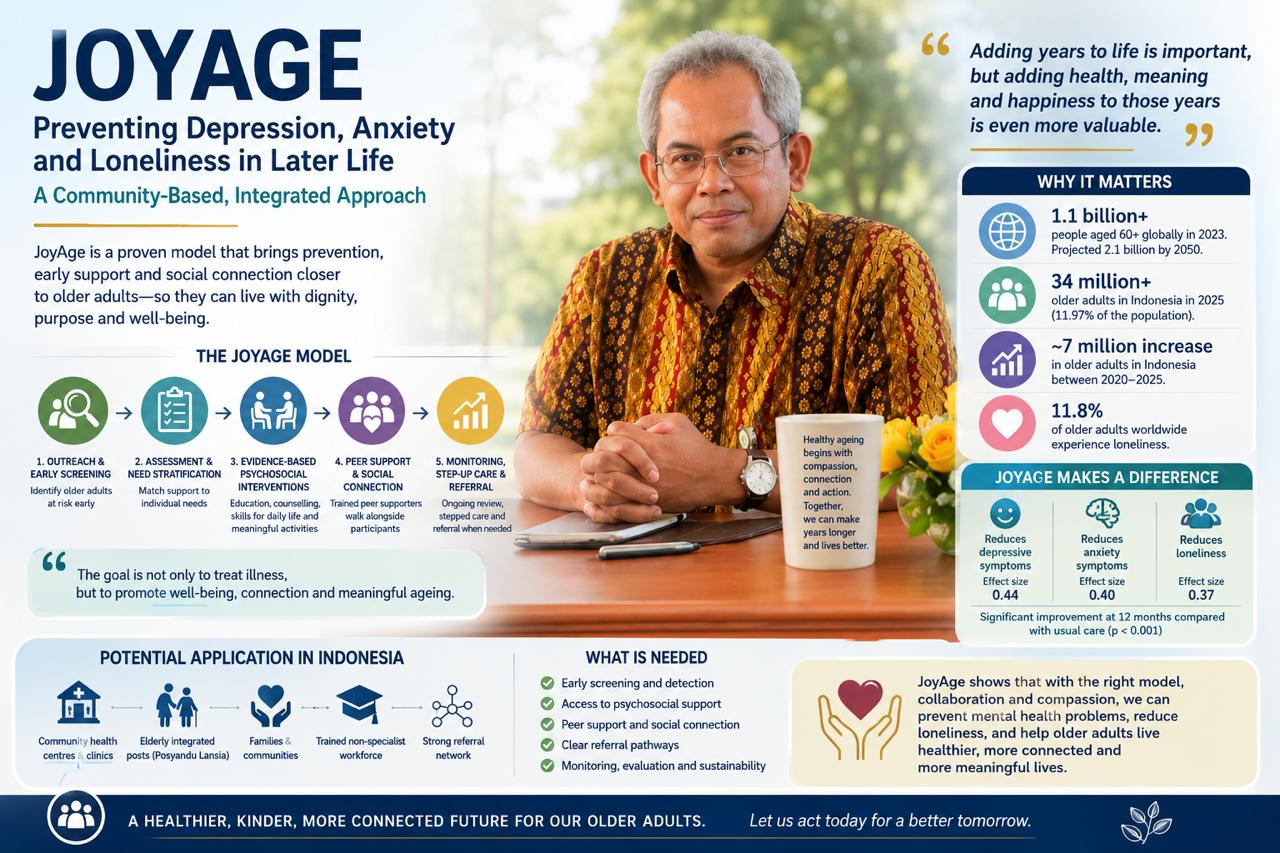
JoyAge and the Future of Mental Health in Later Life in Indonesia
A Community-Based Model for Preventing Depression, Anxiety and Loneliness
Introduction
The world is undergoing a profound demographic transition marked by a rapid rise in both the number and proportion of older people. This trend is an important achievement of human development, reflecting longer life expectancy, improved disease control, better nutrition and sanitation, wider educational opportunities, and greater access to health services. However, living longer does not automatically mean that additional years will be lived in good health, with independence, participation, and a sense of purpose.
Population ageing has multidimensional consequences. Alongside non-communicable diseases, functional decline, rehabilitation needs and long-term care, societies must also respond to mental health challenges in later life. Depression, anxiety, loneliness, loss of social roles and social isolation are frequently missed because they are wrongly assumed to be a normal part of ageing. In reality, these conditions can reduce quality of life, worsen chronic illness, increase dependency and weaken an older person’s ability to remain involved in family and community life.
Within this context, JoyAge is an important model to examine. Developed in Hong Kong, the programme integrates older people’s services, community mental health care, evidence-based psychosocial interventions, peer support and a stepped-care pathway. A large real-world study found that JoyAge was associated with greater reductions in depressive symptoms, anxiety and loneliness than usual care (Liu et al., 2026).
The world is experiencing rapid population ageing
For global statistical purposes, the World Health Organization commonly discusses older people as those aged 60 years and above. In 2020, approximately 1 billion people worldwide were aged 60 or over. This figure rose to around 1.1 billion by 2023 and is projected to reach 1.4 billion by 2030 and about 2.1 billion by 2050 (World Health Organization [WHO], 2025a).
Between 2020 and 2030 alone, the global population aged 60 years and above is therefore expected to increase by roughly 400 million people, representing growth of about 40 per cent in a single decade. By 2030, one in six people worldwide is expected to be aged 60 or older. By 2050, approximately 80 per cent of older people are projected to live in low- and middle-income countries. Population ageing is therefore not simply an issue for wealthy countries; it is a major development challenge for settings where health and social protection systems may still be relatively constrained (WHO, 2025a).
| Indicator | Around 2020 | Latest estimate/projection | Direction |
| People aged 60+ | ≈1.0 billion | ≈1.1 billion in 2023 | Increasing |
| Projected population aged 60+ | — | 1.4 billion by 2030 | ≈40% above 2020 |
| Long-term projection | — | 2.1 billion by 2050 | More than double 2020 |
| Geographical distribution in 2050 | — | ≈80% in low- and middle-income countries | Shift towards developing countries |
These figures show that the global older population is not declining. It is growing steadily. The policy objective is therefore not to reduce the number of older people, but to reduce avoidable illness, disability, dependency, loneliness, depression and unequal access to care.
Population ageing in Indonesia
Indonesia is experiencing the same demographic transition. In 2020, the country had approximately 26.82 million older people, representing 9.92 per cent of the total population. At that stage, Indonesia was already close to the conventional threshold of an ageing population (Badan Pusat Statistik [BPS], 2020).
The 2025 Intercensal Population Survey (SUPAS) reported that the proportion of older people had risen to 11.97 per cent, and BPS formally described Indonesia as having entered the ageing population phase (BPS, 2026a). With a total population of about 284.67 million, this proportion corresponds to an estimated 34.08 million older people. The figure of 34.08 million is a calculated estimate derived from the reported population total and percentage, rather than an absolute count stated directly in the headline BPS release (BPS, 2026a, 2026b).
| Indicator | 2020 | 2025 | Change |
| Share of older people | 9.92% | 11.97% | +2.05 percentage points |
| Estimated number of older people | 26.82 million | ≈34.08 million | +≈7.26 million |
| Relative increase in share | — | — | ≈20.7% |
| Demographic status | Approaching an ageing population | Ageing population | Ageing is increasingly evident |
Over roughly five years, Indonesia’s older population is estimated to have increased by more than 7 million people. The proportion rose by about 20.7 per cent in relative terms, from 9.92 to 11.97 per cent. In practical terms, almost one in eight Indonesians is now an older person.
This demographic shift should not be viewed only as a burden. Older people possess experience, knowledge, skills, social networks and cultural insight that remain valuable to families and communities. These benefits can be sustained only when health and social systems protect functional ability, autonomy, economic security, mental wellbeing and participation.
A growing older population, but limited mental health support
The growth of older populations has not always been matched by sufficient expansion of mental health services. Many countries continue to face shortages of psychiatrists, clinical psychologists, mental health nurses, social workers, counsellors and community-based services.
This mismatch creates a treatment gap: the difference between the number of people who need support and the number who actually receive appropriate care. The gap becomes even wider when services respond only after severe depression, a psychological crisis, a suicide attempt or marked functional decline has already occurred.
Mental health problems in later life are also easily hidden by physical complaints. Depression may present as fatigue, persistent pain, disturbed sleep, reduced appetite, loss of interest, reduced activity or withdrawal from family and community life. These signs may be incorrectly attributed to ageing itself.
WHO estimates that approximately 11.8 per cent of older people worldwide experience loneliness. Applied cautiously to a global population of more than 1.1 billion people aged 60 and above, this would represent nearly 130 million older people. This is an illustrative calculation, because prevalence estimates vary by year, setting, method and definition (WHO, 2025b).
Loneliness is not the same as living alone. A person may live with relatives and still feel unheard, unwanted or emotionally disconnected. Conversely, someone living alone may not be lonely if they have strong, meaningful and dependable social relationships.
Growing older should not mean growing lonely
Ageing is a natural biological and social process, but the experience of ageing is strongly shaped by the surrounding environment. Retirement, bereavement, reduced income, chronic illness, mobility limitations, relocation and the loss of friendships or professional roles may all affect mental wellbeing.
These changes do not inevitably cause mental illness. However, when they occur together without adequate family, social and health-system support, the risk increases. Older people who become unusually quiet, lose interest, sleep poorly, feel worthless, worry excessively, stop joining social activities or say that life has lost meaning should receive careful attention.
What is JoyAge?
JoyAge, formally known as the Jockey Club Holistic Support Project for Elderly Mental Wellness, is an integrated prevention programme developed in Hong Kong. It links older people’s service centres with community mental health units to provide structured support for people with risk factors for late-life depression or subthreshold depressive symptoms.
- collaboration between older people’s services and mental health services;
- early identification of risk factors and depressive symptoms;
- evidence-based psychosocial interventions delivered by trained social workers;
- peer support;
- continuing monitoring; and
- stepped care based on symptom severity and response to intervention.
JoyAge uses a collaborative stepped-care model. People are not automatically referred to specialist services when their needs can safely be addressed through lower-intensity community interventions. Care is stepped up when symptoms are more severe, persistent, unresponsive to initial support or associated with safety risks (JC JoyAge, n.d.-a; Liu et al., 2026).
This approach reflects task-sharing: selected responsibilities are carried out by trained non-specialists under clear protocols, supervision and referral arrangements. The purpose is not to replace psychiatrists or clinical psychologists, but to extend the reach of prevention and early intervention.
Who is JoyAge designed for?
In the JoyAge study, participants were aged 60 years or above and belonged to one of two broad groups. The first group had no clinically significant depressive symptoms but had recognised risk factors. These included loneliness or social isolation, chronic pain, a history of depression or anxiety, bereavement, more than four chronic conditions, or fewer than 30 minutes of meaningful activity per day.
The second group had mild to moderately severe depressive symptoms but did not meet the category of severe depression. Participants with severe depression or suicide risk were promptly referred for specialist mental health care rather than being managed solely through community activities (Liu et al., 2026).
The programme therefore combines selective prevention for people at elevated risk and indicated prevention for people who already show early symptoms but do not yet require immediate specialist treatment.
How does JoyAge work?
1. Outreach and early identification
Participants may be identified through community organisations, older people’s centres, health facilities, families, community activities or open referral. Trained social workers conduct an initial assessment covering depressive symptoms, suicide risk, anxiety, loneliness, social circumstances, cognitive function and individual needs (Liu et al., 2026).
- Patient Health Questionnaire-9 (PHQ-9) for depressive symptoms;
- Generalized Anxiety Disorder-7 (GAD-7) for anxiety; and
- the three-item UCLA Loneliness Scale (UCLA-3) for loneliness.
Screening does not replace clinical diagnosis. It helps determine whether a person needs education, group support, individual psychotherapy, monitoring or referral.
2. Matching the intensity of care to need
People with risk factors but no significant symptoms may receive social engagement and preventive activities. Those with mild symptoms may join group psychoeducation and group psychotherapy, including cognitive behavioural therapy and problem-solving therapy. People with more substantial symptoms may receive individual psychotherapy and referral where necessary. Interventions are delivered by social workers who have completed structured training in geriatric mental health, assessment and adapted psychological therapies (Liu et al., 2026).
3. Evidence-based psychosocial support
- mental health education;
- understanding the links between thoughts, emotions and behaviour;
- increasing meaningful daily activity;
- problem-solving skills;
- emotional regulation;
- strengthening social relationships;
- group or individual counselling; and
- development of a recovery plan.
Behavioural activation is particularly relevant. It helps people gradually re-engage in activities that are enjoyable, meaningful or provide a sense of achievement. In Indonesia, these might include morning walks, gardening, cooking, reading, faith-based activities, older people’s community groups, teaching practical skills, spending purposeful time with grandchildren, or taking part in local social activities.
4. Peer support
Peer support is a distinctive feature of JoyAge. Peer supporters may be older adults who have previously experienced mental health difficulties or related risk factors, have recovered, and have completed structured training.
In the JoyAge study, peer supporters undertook about 100 hours of training, together with field supervision. They assisted with outreach, supported therapy groups, made follow-up visits or calls, and provided continuing encouragement during recovery. Peer support was intended to maintain social connection and reduce the risk of relapse after formal sessions ended (Liu et al., 2026).
Peer supporters do not replace doctors, psychologists, psychiatrists or social workers. Their role is to listen empathically, offer hope, connect people with community resources and help participants remain engaged with their recovery plans.
5. Monitoring, stepping up care and referral
JoyAge services may last between two and twelve months, depending on symptom severity and individual need. After active intervention, participants enter a recovery phase that includes monitoring, periodic contact from peer supporters and discharge planning.
If participants do not improve, develop severe depression or show suicide risk, they are referred to specialist mental health services (Liu et al., 2026).
Outreach → screening → risk stratification → matched intervention → peer support → review → maintenance or stepped-up care → referral when required
Evidence of effectiveness
A 2026 study published in the Journal of Affective Disorders evaluated JoyAge through a pragmatic quasi-experimental trial conducted in routine community settings in Hong Kong. The study therefore examined effectiveness under real-world conditions rather than under a tightly controlled clinical research environment.
The intention-to-treat analysis included 3,416 participants: 2,975 in JoyAge and 441 receiving usual care. The mean age of JoyAge participants was 77.1 years, and 79 per cent were women. Allocation was based on district of residence rather than individual randomisation, which is why the study is described as quasi-experimental rather than a randomised clinical trial (Liu et al., 2026).
| Outcome | Adjusted mean difference | 95% CI | p value | Effect size |
| Depressive symptoms | 1.65 points | 1.24–2.07 | <.001 | 0.44 |
| Anxiety symptoms | 1.47 points | 1.01–1.93 | <.001 | 0.40 |
| Loneliness | 1.29 points | 0.98–1.60 | <.001 | 0.37 |
At 12 months, participants in JoyAge showed statistically greater reductions in depressive symptoms, anxiety and loneliness than those receiving usual care. Effect sizes were small to moderate. Although the average change for each individual was not very large, the findings are still relevant to public health because the programme was delivered at scale to a non-clinical population and aimed to prevent symptoms from worsening.
A p value below .001 means that the observed differences would be very unlikely to arise through random variation alone if there were truly no difference between the groups. However, p values do not indicate the size or clinical importance of benefit. Interpretation must therefore also consider effect size, participant characteristics, scale and the preventive purpose of the programme.
Participant retention
The proportion lost before the 12-month assessment was 9.4 per cent in JoyAge compared with 28.1 per cent in usual care, indicating substantially better retention in the programme. In addition, 90.7 per cent of JoyAge participants completed the service, with a median duration of approximately 9.93 months (Liu et al., 2026).
Sensitivity analysis using propensity score matching
Because the JoyAge group was much larger and baseline characteristics were not fully equivalent, the investigators conducted a sensitivity analysis using propensity score matching. A total of 422 JoyAge participants were matched with 422 usual-care participants on demographic and socioeconomic variables, including age, sex, education, economic status and living arrangements.
The results remained consistent. JoyAge showed greater reductions of 1.99 points for depression, 1.62 points for anxiety and 1.03 points for loneliness. The corresponding effect sizes were 0.48, 0.37 and 0.34 (Liu et al., 2026). This strengthens confidence in the findings, although propensity score matching can account only for variables that were measured and included in the model.
Strengths and limitations of the evidence
- more than 3,400 participants;
- delivery in routine community services;
- 12-month outcome assessment;
- use of standardised instruments;
- intention-to-treat analysis; and
- a matched sensitivity analysis.
The findings should nevertheless be interpreted with appropriate caution. Participants were not individually randomised, and allocation by district may have introduced differences in population characteristics or service environments that could not be fully controlled. Group sizes were also unequal, and the programme contained several interacting components.
The study could not determine the single ‘active ingredient’ responsible for improvement. Benefits may have arisen from psychotherapy, greater social contact, attention from staff, peer support, or the combined package. The most defensible conclusion is therefore that the integrated JoyAge service was associated with better outcomes than usual care under real-world conditions, rather than that one component alone caused the observed improvement.
Why JoyAge matters
JoyAge shifts the point of intervention from late treatment towards prevention and early identification. It does not wait until an older person develops severe depression, loses function or requires hospital care.
Early identification, proportionate intervention, cross-sector collaboration, social support, continuing review and timely referral.
The model also responds to shortages of specialist staff. Trained social workers and peer supporters can undertake clearly defined roles with supervision, while specialist professionals focus on people with severe or complex needs.
JoyAge further demonstrates that preventing late-life depression cannot rely on medicines alone. Loneliness, role loss, inactivity, stigma, family relationships, social belonging and community connection must also be addressed.
Loneliness as a public health issue
A telephone-screening initiative among older people in Hong Kong during the COVID-19 pandemic found that approximately 14 per cent had meaningful depressive symptom scores, 12 per cent had meaningful anxiety scores and 29 per cent had significant loneliness. These were screening findings rather than clinical diagnoses, but they suggest that loneliness may be more widespread than depression or anxiety detected through brief tools (The University of Hong Kong, 2022).
Unaddressed loneliness can form a self-reinforcing cycle. A lonely person may withdraw further, lose activity, confidence and emotional support, and become less likely to seek help. Social relationships should therefore be understood not merely as recreation, but as part of the therapeutic environment and the health-protection system for older people.
Potential adaptation in Indonesia
Indonesia has substantial social assets that could support an adapted JoyAge model, including strong family networks, mutual assistance, community health centres (puskesmas), integrated service posts for older people (posyandu lansia), community health volunteers, faith organisations, universities, professional associations and village government networks.
Adaptation should not mean direct replication. The model would need to be adjusted to local culture and language, primary-care structures, workforce availability, professional regulation, financing, local government capacity, geography, health literacy, and patterns of family and community relationships.
- puskesmas and their outreach networks;
- posyandu lansia;
- clinics and hospitals;
- health and social affairs offices;
- village and urban ward authorities;
- social workers;
- doctors, nurses and psychologists;
- universities;
- community health volunteers;
- faith organisations;
- families; and
- older people’s groups.
A proposed Indonesian pilot model
- Map the target population, particularly older people living alone, recently bereaved, living with chronic illness, socially withdrawn or newly retired.
- Use brief validated screening tools, supported by a clear suicide-risk assessment procedure.
- Stratify need so that people can be directed to education, group activities, brief counselling, medical assessment or specialist referral.
- Offer meaningful social activities such as conversation groups, walking, exercise, gardening, cooking, art, faith activities and intergenerational learning.
- Provide brief psychosocial interventions through trained staff working under protocols and professional supervision.
- Develop peer support with careful selection, training, defined scope, documentation and escalation procedures.
- Use home visits or remote follow-up for people with mobility barriers or those living in hard-to-reach areas.
- Engage families so that relatives recognise early signs of depression, anxiety, functional decline and suicide risk.
- Create referral protocols for severe depression, psychosis, major cognitive impairment, neglect, abuse and emergencies.
- Evaluate process, clinical outcomes, quality of life, social function, retention, safety, cost and participant experience.
Suggested evaluation indicators
| Domain | Example indicator |
| Reach | Number of older people offered and completing screening |
| Access | Time from screening to first intervention |
| Retention | Percentage remaining in the programme |
| Depression | Change in PHQ-9 or another validated measure |
| Anxiety | Change in GAD-7 |
| Loneliness | Change in a validated loneliness scale |
| Social functioning | Frequency of meaningful activity and community participation |
| Safety | Number of suicide-risk cases identified and referred |
| Referral | Percentage completing the referral pathway |
| Participant experience | Satisfaction, dignity and involvement in decisions |
| Economic evaluation | Cost per participant and cost per improved outcome |
| Sustainability | Number of trained people and organisations remaining active |
Evaluation should not be limited to changes in depression scores. A strong programme should also determine whether participants become more active, connected, independent, hopeful and able to obtain timely help.
Who may benefit most?
- people living alone or experiencing social isolation;
- those recently bereaved;
- people newly retired;
- those living with chronic illness or persistent pain;
- people with very limited daily activity;
- those who rarely interact with others;
- people who have lost interest in previously valued activities;
- those who frequently feel sad, anxious, worthless or burdensome;
- people with sleep or appetite changes; and
- those with mild to moderate depressive symptoms.
JoyAge has also expanded to include middle-aged and older adults aged 45 years and above with depressive symptoms. This reflects a life-course approach: prevention can begin before people reach later life with already complex health and social needs (JC JoyAge, 2024).
Strategic implications for Indonesia
With an estimated 34 million older people, Indonesia requires strategies that extend beyond hospitals. Even a community programme reaching only 1 per cent of the older population could potentially serve about 340,000 people. A pilot operating in 100 districts or cities and reaching 1,000 participants in each area would already involve 100,000 older people.
Small-to-moderate individual effects may still produce substantial population benefit when delivered consistently and at scale. Expansion must nevertheless be accompanied by quality, safety, equity and accountability. Particular attention should be given to people in rural, island and remote settings, people with disabilities, those living in poverty and those living alone.
Key message
JoyAge shows that mental health difficulties in later life can be prevented or addressed early through services that are close to people’s everyday lives.
- someone listens;
- an activity restores meaning;
- a peer offers companionship;
- a family understands;
- a trained worker conducts an assessment; and
- a system recognises when care must be stepped up.
The programme changes the way we view mental health in later life. Its purpose is not only to reduce symptoms, but also to protect dignity, functional ability, independence, social relationships, belonging and quality of life.
Adding years to life matters, but adding health, connection, independence and happiness to those years matters even more.
Safety note
JoyAge was developed in the Hong Kong context. Any implementation in Indonesia would require feasibility testing, cultural adaptation, clear professional roles, training standards, supervision, financing and evaluation.
Mental health screening does not replace clinical diagnosis. Any older person with thoughts or plans of self-harm, a suicide attempt, acute confusion, hallucinations, sudden major behavioural change, refusal of food or fluids, or inability to care for themselves should receive urgent professional assessment and referral according to the level of risk.
References
Badan Pusat Statistik. (2020). Statistik penduduk lanjut usia 2020. BPS-Statistics Indonesia.
Badan Pusat Statistik. (2026a, 5 May). SUPAS 2025: Angka kelahiran total (TFR) sebesar 2,13, angka kematian bayi (IMR) sebesar 14,12, dan persentase lansia mencapai 11,97 persen. BPS-Statistics Indonesia.
Badan Pusat Statistik. (2026b). Penduduk dan indikator kependudukan hasil Survei Penduduk Antar Sensus 2025. BPS-Statistics Indonesia.
JC JoyAge. (n.d.-a). About JC JoyAge project. The University of Hong Kong.
JC JoyAge. (n.d.-b). Research scope: Collaborative stepped-care and peer-support services. The University of Hong Kong.
JC JoyAge. (2024). Effectiveness and cost-effectiveness of a collaborative stepped-care model for late-life mental health: JC JoyAge. The University of Hong Kong.
Liu, T., Leung, D. K. Y., Wong, D., Tse, S., Wong, P., Ng, S. M., Chan, W. C., Lou, V., Tang, J. Y.-M., Cheng, R., Lu, S., Wong, F. H. C., Zhang, W., Sze, L. C. Y., Kwok, W. W., Knapp, M., Lum, T. Y. S., & Wong, G. (2026). Effectiveness of an integrated prevention programme (‘JoyAge’) for depressive symptoms, anxiety, and loneliness in older adults in Hong Kong: A pragmatic quasi-experimental trial. Journal of Affective Disorders, 402, Article 121333. https://doi.org/10.1016/j.jad.2026.121333
The University of Hong Kong. (2022). Survey reveals over a third of older adults in Hong Kong suffered from emotional distress in the fifth wave of COVID-19.
World Health Organization. (n.d.). Ageing. WHO.
World Health Organization. (2025a). Ageing: Global population. WHO.
World Health Organization. (2025b). Reducing social isolation and loneliness among older people. WHO.
World Health Organization. (2025c). From loneliness to social connection: Charting a path to healthier societies—Report of the WHO Commission on Social Connection. WHO.