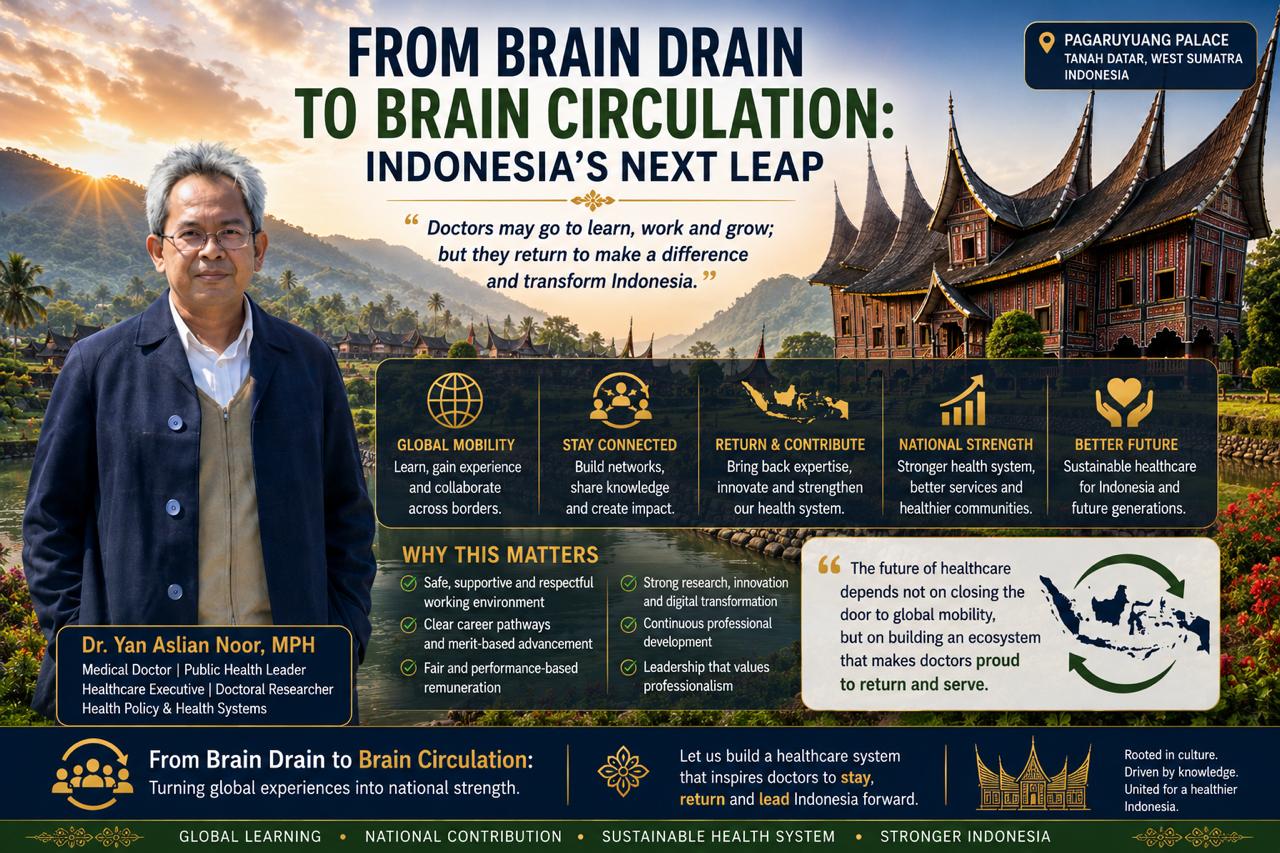
From Brain Drain to Brain Circulation: Is Indonesia Asking the Wrong Question?
“The future of Indonesia’s healthcare system will not be determined by how many doctors leave. It will be determined by how many choose to return.”
For decades, the debate on physician migration has revolved around a single concern: How can we prevent doctors from leaving Indonesia?
But after participating in an international academic discussion on physician migration involving experts from Indonesia and Türkiye, I found myself questioning whether we have been asking the wrong question all along.
Perhaps the real issue is not brain drain.
Perhaps the real issue is whether Indonesia has created a healthcare system that talented doctors genuinely want to return to.
One remark from the discussion has stayed with me: “Doctors may leave to learn, work, and grow—but the real question is whether they will choose to come back.”
That sentence fundamentally changes how we should think about healthcare workforce policy.
The World Has Changed—Has Our Thinking Changed Too?
Global mobility is no longer an exception; it is becoming the norm.
Doctors pursue postgraduate education, advanced clinical training, international research, and multidisciplinary collaboration across borders. Attempting to prevent this movement is neither realistic nor consistent with the principles of an increasingly interconnected world.
The strategic challenge is therefore no longer how to stop doctors from leaving, but how to ensure that global experience ultimately strengthens Indonesia’s healthcare system.
That is the essence of brain circulation.
Indonesia May Be Facing an Invisible Risk
At first glance, Indonesia appears to experience relatively limited international physician migration.
Many might interpret this as a successful retention policy.
I believe that conclusion deserves careful scrutiny.
Current migration may still be constrained by structural barriers such as licensing examinations, language proficiency, visa regulations, immigration policies, and professional recognition.
If these barriers continue to decline—as they increasingly do through global workforce mobility—the number of Indonesian doctors seeking international careers could rise significantly.
In other words, today’s low migration may reflect high barriers, not necessarily high satisfaction.
That distinction is critically important for policymakers.
Doctors Do Not Leave Only Because of Money
One of the most insightful discussions during the seminar challenged another common assumption.
Salary certainly matters.
But it is rarely the only reason physicians decide to migrate.
Professional fulfilment is shaped by three interconnected elements: Motivation, Ability, and Opportunity
A highly motivated doctor with excellent clinical competence cannot perform optimally without an organisation that provides opportunities to grow, innovate, conduct research, lead multidisciplinary teams, and develop professionally.
Talent flourishes where opportunity exists.
Generation Z Is Changing the Rules
The next generation of doctors is entering the profession with different expectations.
Competitive remuneration remains important.
However, many young physicians are equally concerned about: meaningful careers, supportive leadership, continuous learning, research opportunities, work-life balance, psychological safety, digital innovation, and organisational culture.
These are no longer additional benefits.
They are becoming essential determinants of workforce retention.
From Brain Drain to Brain Circulation
Instead of asking: “How do we stop Indonesian doctors from leaving?”
perhaps we should ask: “How do we make Indonesia the country they are proud to return to?”
Imagine an ecosystem where Indonesian doctors are encouraged to:
- pursue specialist training abroad;
- participate in international research;
- collaborate with global centres of excellence;
- develop new innovations;
and then return—or remain professionally connected—to strengthen Indonesia through education, clinical leadership, research, digital health, and health policy.
That is not a loss of talent.
That is an investment in national capability.
A Final Reflection
Patriotism cannot be sustained by rhetoric alone.
It grows when professionals believe their country values their expertise, respects their contribution, and provides a future worth building.
Ultimately, the strongest healthcare system is not the one that closes its doors to global mobility.
It is the one that transforms global knowledge into national strength.
Perhaps Indonesia’s greatest challenge is not preventing brain drain.
Perhaps it is creating an ecosystem where brain circulation becomes a national competitive advantage.
What do you think?
Should Indonesia continue focusing on preventing physician migration, or is it time to redesign our health workforce strategy around brain circulation, global collaboration, and long-term professional engagement?
I look forward to hearing perspectives from colleagues in healthcare, academia, public policy, and medical education.