Building Intelligent Leadership for the Future of Hospitals
Healthcare is entering a new era. Artificial Intelligence (AI), digital health, interoperable data, and Value-Based Healthcare are reshaping how hospitals diagnose disease, coordinate care, and make clinical decisions. Yet despite these remarkable technological advances, one of the greatest challenges in healthcare remains surprisingly unchanged: communication.
Across healthcare systems worldwide, ineffective communication continues to contribute to patient harm, fragmented care, delayed decision-making, and avoidable inefficiencies. While hospitals are becoming increasingly data-rich, many still struggle to become communication-rich organisations capable of translating information into coordinated action and continuous learning.
This raises an important question.
Can digital transformation succeed without transforming leadership and organisational communication?
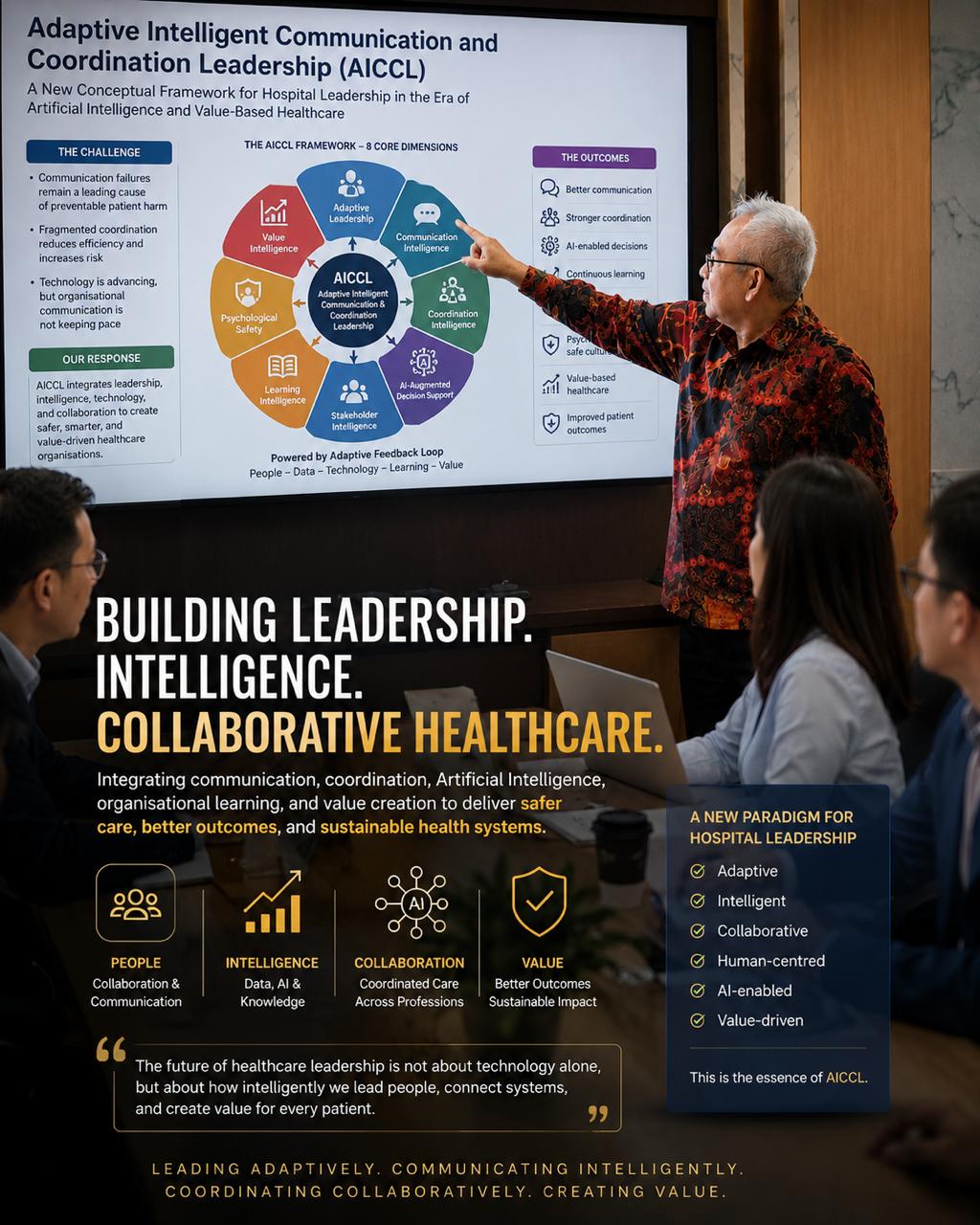
My recent conceptual study proposes a new answer through the development of Adaptive Intelligent Communication and Coordination Leadership (AICCL).
Rather than viewing communication simply as the exchange of information, AICCL redefines it as a strategic organisational capability. It integrates adaptive leadership, communication intelligence, coordination intelligence, AI-augmented decision support, organisational learning, psychological safety, stakeholder engagement, and value creation into a single conceptual framework.
The proposed model argues that future hospital leaders must do far more than manage technology. They must be capable of connecting people, data, clinical expertise, and intelligent systems to create organisations that continuously learn, adapt, and improve.
In this framework, Artificial Intelligence is not intended to replace human judgement. Instead, it strengthens clinical reasoning, supports collaborative decision-making, enhances organisational learning, and enables more effective communication across professional boundaries.
Ultimately, the future of healthcare leadership will not be defined by how much technology hospitals possess, but by how intelligently leaders use communication, coordination, and organisational learning to improve patient outcomes.
I hope the Adaptive Intelligent Communication and Coordination Leadership (AICCL) framework will stimulate further discussion and empirical research on the future of hospital leadership in the era of Artificial Intelligence and Value-Based Healthcare. It is intended not as a final answer, but as a starting point for rethinking how leadership can evolve to meet the growing complexity of modern healthcare.
Because in the age of AI, the most valuable technology may still be intelligent leadership.
Dr Yan Aslian Noor, MPH, FISQua
Doctoral Candidate in Environmental Science
Hospital Management and Healthcare Leadership