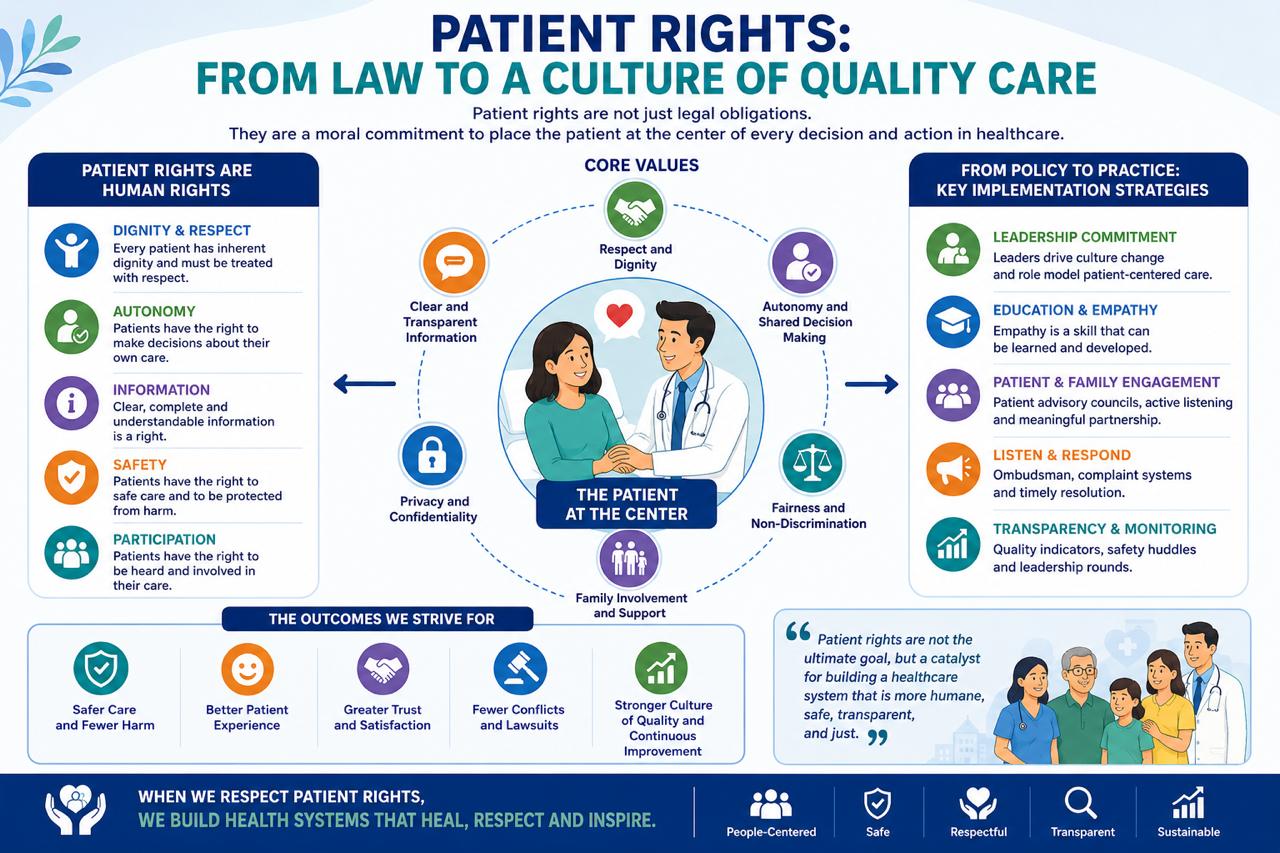
Beyond Legal Compliance: Patient Rights as the Foundation of Clinical Governance and Cultural Transformation in Healthcare
Reflections from the ISQua–Sobrasp International Webinar
By Dr. Yan Aslian Noor, MPH, FISQua
Doctoral Candidate in Environmental Science, Hasanuddin University, Indonesia
Beyond Legal Compliance: Why Patient Rights Matter More Than Ever
Healthcare systems across the world are experiencing a profound paradigm shift. For decades, success was primarily measured by expanding access to healthcare services, increasing technological sophistication, and improving organisational efficiency. While these remain essential, contemporary healthcare quality has increasingly been redefined by a more fundamental principle: respect for the dignity, autonomy, and rights of every patient.
The recent ISQua–Sobrasp international webinar on the newly approved Brazilian Patient Rights Statute demonstrated that patient rights should no longer be viewed merely as legal provisions designed to prevent litigation. Instead, they represent a strategic framework capable of transforming organisational culture, strengthening clinical governance, improving patient safety, and restoring trust between healthcare professionals and society.
This discussion is particularly relevant for low- and middle-income countries, including Indonesia, where health systems continue to pursue universal health coverage while simultaneously facing increasing expectations regarding quality, transparency, patient engagement, and accountability.
Patient Rights: From Human Rights to Healthcare Quality
One of the most compelling arguments presented by Professor Aline Albuquerque was that patient rights are not new rights. Rather, they constitute the practical application of universal human rights within healthcare.
This distinction is critically important.
Human rights are inherently universal, yet they remain abstract unless translated into everyday clinical practice. Patient rights therefore serve as the bridge between ethical principles and healthcare delivery. Rights such as informed consent, dignity, privacy, confidentiality, non-discrimination, shared decision-making, and access to information transform philosophical values into operational standards for healthcare organisations.
Importantly, Professor Albuquerque argued that these rights should not continuously evolve every time new technologies emerge. Artificial intelligence, digital health, precision medicine, and telemedicine do not require entirely new patient rights; rather, they require new ways of implementing existing rights.
This perspective reflects the enduring ethical principles articulated by Beauchamp and Childress (2019), demonstrating that technological innovation must remain subordinate to human dignity rather than redefining it.
The Real Challenge Is Not Legislation—It Is Culture
Perhaps the most significant insight from the webinar was that legislation alone cannot transform healthcare practice.
Dr Cláudia Matias repeatedly emphasised that the greatest barrier to implementing patient rights is neither financial resources nor legal complexity. Instead, it is organisational culture.
Hospitals often invest heavily in infrastructure, accreditation, digital transformation, and clinical protocols. Yet genuine patient-centred care cannot be achieved without transforming the underlying beliefs and behaviours that shape everyday interactions between healthcare professionals, patients, and families.
Organisational culture determines whether professionals genuinely listen to patients, whether leadership welcomes criticism, whether communication remains empathetic under pressure, and whether patients become partners rather than passive recipients of care.
Edgar Schein’s theory of organisational culture provides a compelling explanation for this phenomenon. Culture is sustained not by written policies but by deeply embedded assumptions regarding “how things are done here.” Consequently, patient rights legislation should be understood as a catalyst for cultural transformation rather than merely a legal instrument (Schein & Schein, 2017).
Patient Rights and Patient Safety: Two Sides of the Same Coin
Another important message emerging from the discussion was the inseparable relationship between patient rights and patient safety.
Historically, patient safety initiatives have concentrated on preventing adverse events through clinical protocols, reporting systems, and risk management. While these approaches remain indispensable, they are insufficient if patients themselves remain excluded from decision-making.
The World Health Organization’s Charter of Patient Safety Rights (2024) reinforces this perspective by explicitly recognising patient safety as a human rights issue.
Patients who understand their treatment, participate in clinical decisions, ask questions, and report concerns become active contributors to safer healthcare. Their voices represent valuable safety intelligence rather than organisational inconvenience.
This represents a profound shift from viewing patients as passive beneficiaries towards recognising them as co-producers of healthcare quality.
Complaint Systems Should Become Learning Systems
One discussion particularly resonated with me during the webinar, especially following my question concerning implementation.
Professor Albuquerque explained that countries with mature patient rights legislation have not primarily reduced litigation through stricter laws. Instead, they have established sophisticated mechanisms for conflict resolution before disputes escalate into legal proceedings.
Examples include Patient Ombudsman Offices, NHS Resolution in England, independent complaint agencies in Denmark, and similar structures across Canada and Austria.
Dr Matias expanded this argument by demonstrating that complaint systems should never function merely as administrative departments.
Instead, every complaint should initiate organisational learning through:
- root cause analysis;
- multidisciplinary discussion;
- leadership involvement;
- continuous quality improvement;
- transparent communication with patients and families.
In other words, every complaint represents an opportunity to improve the healthcare system rather than defend it.
This philosophy strongly reflects the concept of the Learning Health System, where every patient interaction continuously improves future care (Institute of Medicine, 2001).
Leadership Is the Decisive Factor
The webinar also highlighted that patient rights cannot become organisational reality without visible leadership commitment.
Leadership extends far beyond approving policies.
It involves:
- conducting leadership safety rounds;
- promoting psychological safety among staff;
- supporting patient advisory councils;
- strengthening ombudsman services;
- embedding empathy into professional education;
- monitoring implementation through governance structures.
Most importantly, leadership must communicate consistently that respecting patient rights is not optional—it is fundamental to professional excellence.
As Dr Matias eloquently stated, empathy is not an innate talent but a professional competency that can—and must—be learned.
This statement deserves serious reflection within healthcare education worldwide.
A Philosophical Shift Towards Human-Centred Healthcare
From a philosophical perspective, the Brazilian Patient Rights Statute represents far more than legislative reform.
It reflects an epistemological transformation.
Traditional biomedical paradigms largely positioned patients as objects of diagnosis and treatment. Contemporary healthcare increasingly recognises patients as moral subjects possessing values, preferences, lived experiences, and legitimate voices within clinical decision-making.
This transition closely aligns with Jürgen Habermas’ concept of communicative action, whereby ethical legitimacy emerges through dialogue rather than authority alone (Habermas, 1984).
Healthcare quality therefore becomes inseparable from communication quality.
Clinical excellence without respectful dialogue is no longer sufficient.
Implications for Indonesia and Other Developing Health Systems
For Indonesia, these reflections are particularly timely.
Significant progress has already been achieved through national accreditation standards, Clinical Governance initiatives, Patient Safety programmes, electronic medical records, and Universal Health Coverage.
Nevertheless, the next stage of healthcare reform should move beyond regulatory compliance towards cultivating genuinely patient-centred organisational cultures.
Rather than asking whether hospitals comply with standards, healthcare leaders should begin asking more challenging questions:
- Do patients genuinely feel heard?
- Are families regarded as partners?
- Is empathy systematically taught and evaluated?
- Does every complaint improve the organisation?
- Can patients meaningfully participate in decisions affecting their care?
These questions may ultimately prove more important than traditional accreditation metrics.
Conclusion
The ISQua–Sobrasp discussion reaffirmed that patient rights should never be interpreted merely as legal obligations.
They represent a moral commitment, a governance strategy, a patient safety intervention, and ultimately a measure of healthcare civilisation.
Healthcare systems of the future will not be distinguished solely by technological sophistication or financial investment.
They will be distinguished by their ability to respect human dignity, foster meaningful partnerships with patients, learn continuously from experience, and embed compassion into everyday clinical practice.
Patient rights are therefore not the final destination.
They are the foundation upon which trustworthy, safe, equitable, and sustainable healthcare systems are built.
References
Barry, M. J., & Edgman-Levitan, S. (2012). Shared decision making—The pinnacle of patient-centred care. New England Journal of Medicine, 366(9), 780–781.
Beauchamp, T. L., & Childress, J. F. (2019). Principles of Biomedical Ethics (8th ed.). Oxford University Press.
Berwick, D. M. (2009). What ‘patient-centred’ should mean: Confessions of an extremist. Health Affairs, 28(4), w555–w565.
Donabedian, A. (1988). The quality of care: How can it be assessed? JAMA, 260(12), 1743–1748.
Epstein, R. M., & Street, R. L. (2007). Patient-Centered Communication in Cancer Care. National Cancer Institute.
Habermas, J. (1984). The Theory of Communicative Action. Beacon Press.
Institute of Medicine. (2001). Crossing the Quality Chasm: A New Health System for the 21st Century. National Academies Press.
Schein, E. H., & Schein, P. A. (2017). Organizational Culture and Leadership (5th ed.). Wiley.
World Health Organization. (2021). Global Patient Safety Action Plan 2021–2030. WHO.
World Health Organization. (2024). Charter of Patient Safety Rights. WHO.