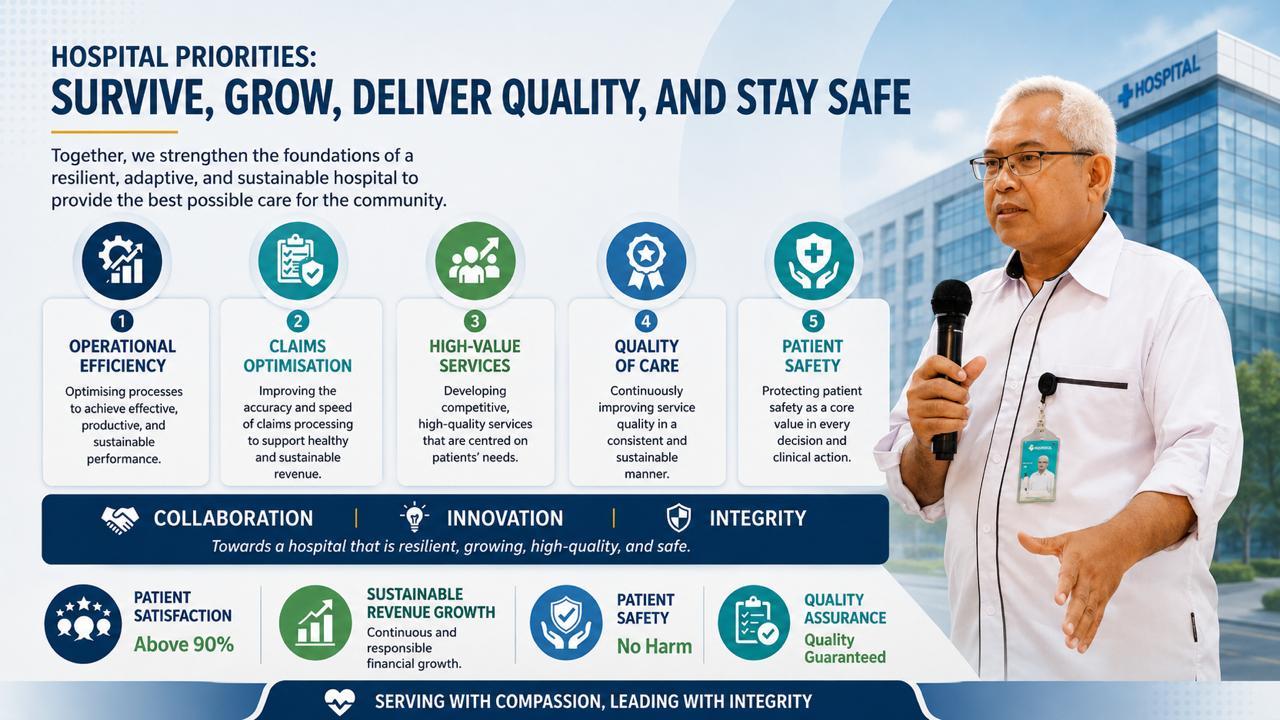
Hospital Priorities: Survive, Grow, Deliver Quality, And Stay Safe
A Strategic Framework for Revenue Growth, Operational Efficiency, Quality of Care, and Patient Safety
Hospital Policy and Management Analysis
Prepared to support evidence-based, value-driven, and regulation-compliant hospital decision-making in 2026
Executive Summary
“Hospital Priorities: Survive, Grow, Deliver Quality, and Stay Safe” communicates one central strategic message: a hospital should not pursue financial sustainability by increasing unnecessary procedures or lowering clinical standards. Instead, sustainable revenue should come from better value—improved clinical outcomes, a better patient experience, and more efficient use of resources.
Hospitals face several pressures at the same time: rising prices of medicines and medical devices, workforce shortages and remuneration demands, changing disease patterns, higher patient expectations, stronger competition, and heavy dependence on National Health Insurance (JKN) payments. In this environment, a sound survival strategy must integrate five priorities: operational efficiency, claims optimisation, development of high-value services, quality improvement, and patient safety.
Healthy revenue is the result of care that is appropriate, safe, efficient, accurately documented, and trusted by the public—not simply the result of higher service volume.
Key Evidence Supporting the Argument
| Indicator | Evidence | Strategic Meaning |
| Global patient safety | About 1 in 10 patients experiences harm, and more than 3 million deaths each year are associated with unsafe care. | Patient safety is both a clinical and financial priority. |
| Cost of unsafe care | Around 15% of hospital expenditure and activity in OECD countries is linked to managing patient harm. | Preventing harm is a direct efficiency strategy. |
| Global health spending | US$9.8 trillion in 2021, equal to 10.3% of global GDP. | Cost pressure is a global health-system challenge. |
| JKN coverage | 284,337,094 participants as of 30 April 2026. | JKN remains the main market and revenue source for many Indonesian hospitals. |
| National quality framework | Ministerial Regulation No. 30/2022 sets national quality indicators; Ministerial Decree No. 1596/2024 updates hospital accreditation standards. | Quality must be measured and linked to governance. |
1. Strategic Meaning
The hospital leader is placed at the centre of the composition and surrounded by a modern hospital, health professionals, a growth chart, a safety shield, and a quality badge. This visual design shows that hospital success depends on leadership that can balance four mandates: financial sustainability, service growth, clinical quality, and patient safety.
1.1 Survive
To survive means maintaining liquidity, paying staff and suppliers on time, protecting essential services, and controlling revenue risk. Key indicators include cash flow, ageing receivables, cost per case, asset productivity, claims turnaround time, and the ability to meet short-term obligations.
1.2 Grow
Growth means expanding services that are genuinely needed by the population and are both clinically and financially feasible. Healthy growth is based on disease burden, workforce competence, technology readiness, referral networks, and unit-cost analysis.
1.3 Deliver Quality
Quality means consistent, measurable, evidence-based, timely, equitable, and patient-centred care. It is not limited to passing accreditation; it is the ability of the organisation to maintain reliable processes every day.
1.4 Stay Safe
Safety means controlling clinical and non-clinical risks through correct patient identification, effective communication, medication safety, safe surgery, infection prevention, fall prevention, facility safety, and learning from incidents without a blame culture.
2. Global Context
The World Health Organization places patient safety at the foundation of health care. The Global Patient Safety Report 2024 shows that countries are progressing at different rates in implementing safety policies, incident reporting, workforce education, and patient engagement. The WHO Global Patient Safety Action Plan 2021–2030 provides a strategic direction for eliminating avoidable harm.
From an economic perspective, the OECD estimates that about 15% of hospital expenditure and activity may be used to manage the consequences of patient harm. Unsafe care therefore creates direct treatment costs, longer stays, rework, litigation, and loss of public trust. Patient safety should consequently be treated as a financial strategy, not merely a compliance requirement.
Global health expenditure reached US$9.8 trillion in 2021, equivalent to 10.3% of global GDP. This trend strengthens the case for better productivity, appropriate care pathways, safe substitution of inpatient care with day care, selective use of technology, and reduction of low-value care.
3. Indonesian National Context
JKN has become a major driver of hospital utilisation and revenue. By 30 April 2026, JKN membership had reached 284,337,094 people. This broad coverage creates service opportunities, but also places pressure on hospital cash flow because of incomplete documentation, coding errors, verification processes, pending claims, disputes, and differences between actual costs and package-based tariffs.
Ministerial Regulation No. 3 of 2023 sets JKN service tariffs at primary and referral levels, including INA-CBG and non-INA-CBG payment mechanisms. Because referral hospitals are largely paid through case-based packages, they must manage cost per episode rather than simply increase the number of procedures. Clinical pathways, formularies, length of stay, discharge planning, and complication prevention are therefore financial as well as clinical tools.
Ministerial Regulation No. 30 of 2022 requires health facilities, including hospitals, to measure National Quality Indicators. Ministerial Decree HK.01.07/MENKES/1596/2024 updates Hospital Accreditation Standards and reinforces the relationship between governance, patient-centred care, continuous quality improvement, and safety. Revenue growth must therefore remain within a measurable quality and continuous accreditation framework.
4. The Five Priority Pillars
4.1 Operational Efficiency
Efficiency does not mean cutting necessary care. It means removing waste and unwarranted variation. Priority actions include improving patient flow, operating theatre scheduling, length-of-stay management, bed turnover, inventory control, clinical pathway standardisation, and optimal use of diagnostic assets.
Suggested indicators: bed occupancy rate, average length of stay, turnover interval, bed turnover, waiting time, operating theatre utilisation, stock-outs, expired inventory, and cost per case.
4.2 Claims and Revenue-Cycle Optimisation
The revenue cycle begins at registration and continues through eligibility, clinical documentation, coding, internal verification, claim submission, reconciliation, and payment. Claims optimisation must remain ethical: the objective is better accuracy and completeness, not upcoding or unnecessary services.
Suggested indicators: clean-claim rate, pending claims, dispute rate, days in accounts receivable, denial rate, and consistency between service records and claims.
4.3 Development of High-Value Services
New services should be selected according to disease burden, local need, clinical capability, referral networks, and a sound business case. Potential services include day surgery, rehabilitation, haemodialysis, maternal and child care, chronic disease services, medical check-ups, home care, telemedicine, and executive services.
Suggested indicators: case volume, contribution margin, waiting time, clinical outcome, market share, and patient satisfaction.
4.4 Quality of Care
Quality should be managed through a formal quality and patient safety structure, indicator measurement, clinical audit, tracer methodology, clinical pathway compliance, and Plan-Do-Study-Act cycles. Quality data should be reviewed together with financial data so leaders can see the costs of variation, delay, rework, and complications.
Suggested indicators: patient identification compliance, waiting time, pathway adherence, readmission, risk-adjusted mortality, and patient-reported experience.
4.5 Patient Safety
Safety priorities include a strong safety culture, incident reporting, root-cause analysis, medication safety, infection prevention and control, safe surgery, diagnostic safety, and effective handovers. Incidents should be used to improve systems rather than to blame individuals.
Suggested indicators: safety incidents, healthcare-associated infections, medication errors, falls, pressure injuries, surgical-site infections, and near-miss reporting.
5. Executive Priority Matrix
| Priority | First 90 Days | Revenue Effect | Quality Safeguard | Accountable Lead |
| Revenue cycle | Establish a claims war room; audit the 20 highest-volume diagnoses/CBGs; standardise clinical documentation. | Faster cash conversion and fewer pending claims. | Coding audit, anti-fraud controls, clinical verification. | Finance Director, Medical Director, Casemix Team |
| Process efficiency | Map the emergency–inpatient–discharge pathway and remove bottlenecks. | Higher throughput without unsafe workload. | Escalation criteria and safe staffing. | Operations/Services Director |
| Unit cost | Calculate costs of high-volume and loss-making services. | Supports pricing, cost control, and portfolio decisions. | Do not cut clinically essential inputs. | Finance, Medical Committee, Pharmacy |
| High-value services | Prepare business cases and readiness assessments. | Creates relevant new revenue streams. | Credentialing, SOPs, equipment and emergency readiness. | Chief Executive and Service Development Team |
| Patient safety | Prioritise the three highest clinical and financial risks. | Reduces complications, rework, length of stay, and litigation. | Root-cause analysis, PDSA, incident dashboard. | Medical Director, Quality Committee |
6. A Balanced Financial and Clinical Dashboard
Hospital executives should monitor an integrated dashboard so that revenue targets do not encourage unsafe behaviour. Every financial indicator should be paired with a clinical balancing measure.
| Goal | Primary Indicator | Balancing Indicator |
| Increase inpatient activity | Bed occupancy, bed turnover, revenue per bed | Length of stay, mortality, infection, readmission |
| Increase surgical activity | Operating theatre utilisation, margin per case | Cancellations, surgical-site infection, checklist compliance |
| Reduce medicine costs | Pharmacy cost per case | Medication errors, stock-outs, formulary compliance |
| Accelerate discharge | Length of stay and discharge before noon | 7- and 30-day readmission, complaints |
| Improve claims | Clean-claim rate, collection period | Coding accuracy, fraud signals, clinical appropriateness |
7. Alignment with Regulations and Policies, 2021–2026
| Regulation/Policy | Implication for Hospitals |
| WHO Global Patient Safety Action Plan 2021–2030 | Requires a systems approach, safety culture, patient engagement, workforce education, and harm measurement. |
| Ministerial Regulation No. 30 of 2022 | Establishes National Quality Indicators that hospitals must measure, analyse, and use for improvement. |
| Ministerial Regulation No. 24 of 2022 on Medical Records | Accelerates electronic medical records, affecting continuity of care, coding, audit, and claims. |
| Ministerial Regulation No. 3 of 2023 | Sets JKN tariffs and reinforces episode-based cost management. |
| Law No. 17 of 2023 on Health | Places quality, safety, patient rights, facility governance, health information, and financing within the national health system. |
| Government Regulation No. 28 of 2024 | Implements Law No. 17/2023 and details health service facilities, quality, workforce, technology, supervision, and governance. |
| Presidential Regulation No. 59 of 2024 | The third amendment to JKN governance; requires hospital readiness for benefit and inpatient-class standardisation. |
| Ministerial Decree HK.01.07/MENKES/1596/2024 | Provides the latest Hospital Accreditation Standards for governance, care delivery, quality, and safety. |
8. Implementation Roadmap
Phase 1: Stabilise (0–3 months)
- Create a joint revenue–quality command centre and agree on ten priority indicators.
- Audit pending and disputed claims, medical records, coding, and the 20 largest CBG groups.
- Identify the three patient-safety risks with the greatest clinical and financial impact.
- Calculate unit costs for high-volume services and services with negative margins.
Phase 2: Optimise (4–12 months)
- Implement clinical pathways for priority conditions and build a real-time dashboard.
- Optimise operating theatre schedules, laboratory, radiology, pharmacy, and discharge planning.
- Strengthen electronic medical records, SATUSEHAT integration, clinical documentation improvement, and the revenue cycle.
- Launch high-value services that pass the business-case and readiness assessment.
Phase 3: Grow through Value (12–36 months)
- Develop outcome- and efficiency-based contracts and incentives.
- Use predictive analytics for demand, clinical risk, and claim-denial prevention.
- Build referral networks, home care, telemedicine, and integrated services.
- Publish quality and safety performance to strengthen public trust.
9. Ethical and Patient-Safety Red Lines
- Do not provide procedures without clinical indication merely to increase revenue.
- Do not use upcoding, claim splitting, or documentation manipulation.
- Do not reduce staffing, medicines, equipment, investigations, or observation time below safe clinical requirements.
- Do not delay emergency treatment because of administration or payment issues.
- Do not open a new service before credentialing, SOPs, staff, equipment, medicines, and emergency back-up are ready.
- Do not conceal incidents; every incident should be analysed as an opportunity for system improvement.
10. Conclusion
The illustration presents a hospital that survives and grows by balancing revenue, efficiency, quality, and patient safety. A financial strategy that neglects safety will increase complications, length of stay, readmission, complaints, litigation, and reputational loss. Conversely, quality and safety managed as an organisational system can reduce waste, improve patient flow, strengthen claims, and increase patient loyalty.
The best priority for hospital leaders is to build a value-based operating model: the right care, for the right patient, at the right time, at a controlled cost, with accurate documentation and measurable clinical outcomes. This approach allows a hospital to remain financially viable without compromising its primary duty—to protect patients.
References and Key Regulations
Badan Penyelenggara Jaminan Sosial Kesehatan. (2026). JKN membership data as of 30 April 2026.
Kementerian Kesehatan Republik Indonesia. (2022). Ministerial Regulation No. 24 of 2022 on Medical Records.
Kementerian Kesehatan Republik Indonesia. (2022). Ministerial Regulation No. 30 of 2022 on National Quality Indicators for Health Services.
Kementerian Kesehatan Republik Indonesia. (2023). Ministerial Regulation No. 3 of 2023 on Health Service Tariffs under the National Health Insurance Programme.
Kementerian Kesehatan Republik Indonesia. (2024). Ministerial Decree HK.01.07/MENKES/1596/2024 on Hospital Accreditation Standards.
Organisation for Economic Co-operation and Development. (2022). The economics of patient safety: From analysis to action. OECD Publishing.
Organisation for Economic Co-operation and Development. (2023). Advancing patient safety governance and implementation. OECD Health Working Papers.
President of the Republic of Indonesia. (2024). Presidential Regulation No. 59 of 2024 on the Third Amendment to Presidential Regulation No. 82 of 2018 on National Health Insurance.
Republic of Indonesia. (2023). Law No. 17 of 2023 on Health.
Republic of Indonesia. (2024). Government Regulation No. 28 of 2024 on the Implementation of Law No. 17 of 2023 on Health.
World Health Organization. (2021). Global patient safety action plan 2021–2030: Towards eliminating avoidable harm in health care.
World Health Organization. (2024). Global patient safety report 2024.
World Health Organization. (2024). Global spending on health: Coping with the pandemic.
World Health Organization. (2024). Patient safety rights charter.