Reflection on My Participation in the ISQua COPLAC Webinar
I am truly grateful for the opportunity to participate in the ISQua COPLAC webinar held on Thursday, 25 June 2026, entitled “Estatuto dos Direitos do Paciente no Brasil: perspectivas de aplicação nos serviços de saúde” — “The Statute of Patients’ Rights in Brazil: Perspectives on Its Application in Health Services.” This session provided me with valuable insight into the importance of patients’ rights, patient safety, and their practical relevance to improving the quality of healthcare services.
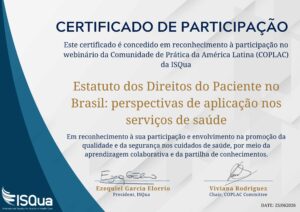
Through this webinar, I gained a deeper understanding that hospital quality is not only related to service standards, clinical indicators, or regulatory compliance. More importantly, it is also about respecting patients’ dignity, voices, experiences, and rights as the central focus of the entire care process. The discussion on Patient Rights and the Patient Revolution was particularly relevant in strengthening a healthcare culture that is more transparent, participatory, safe, and responsive to the needs of patients.
One of the most interesting lessons from this webinar was how Brazil is strengthening patients’ rights through a more structured approach known as the Estatuto dos Direitos do Paciente, or the Statute of Patients’ Rights. This framework emphasises several important principles, including patient autonomy, meaningful informed consent, the right to appoint a representative, respect for patients’ wishes, the right to be accompanied during consultations or treatment, and the guarantee of safe and high-quality care. In Brazil, this statute is also intended to apply across both public and private healthcare services, making patients’ rights not only an ethical principle, but also a clearer legal and cultural foundation for healthcare delivery.
This learning experience offers valuable additional perspectives for Indonesia. Indonesia already has regulations concerning the rights and responsibilities of patients, including provisions under Law Number 17 of 2023 on Health. However, the Brazilian experience provides an inspiring example of how patients’ rights can be implemented more visibly and consistently at hospital level. Patients’ rights should not simply be presented as written information, displayed documents, or administrative requirements; they should become an integral part of the culture of quality and safety within healthcare organisations.
For hospitals in Indonesia, several practical ideas can be further developed. These include strengthening patient education using clear and accessible language, ensuring that informed consent becomes a genuine two-way conversation, giving patients and families greater involvement in clinical decision-making, and building patient feedback mechanisms that are genuinely used for quality improvement. Such an approach can help hospitals move beyond mere regulatory compliance towards care that is more humane, collaborative, and truly patient-centred.
I sincerely appreciate ISQua and COPLAC for providing an international platform for collaborative learning and knowledge sharing. My participation in this webinar forms part of my ongoing commitment to continuous professional development, broadening my international perspective, and contributing to the strengthening of healthcare quality and patient safety in Indonesia.